Antoine de Saint-Exupéry's book The Little Prince is a beloved work of literature that transcends its status as a children's book, engaging with deep existential and philosophical themes. While the historical evidence connecting Martin Heidegger and Saint-Exupéry is sparse, the existing records reveal intriguing points of contact and provide a compelling starting point for a philosophical comparison. By examining The Little Prince through the lens of Heidegger's philosophy, I argue that there are significant parallels that suggest Saint-Exupéry's work can be understood as a poetic disclosure of Being in the Heideggerian sense—particularly in its reflections on authenticity, dwelling, homelessness, and technology.
My aim in this essay is not to establish a direct line of influence between Heidegger and Saint-Exupéry. At present, there is no evidence demonstrating that Saint-Exupéry was familiar with Heidegger's writings, nor that Heidegger developed his philosophy through any sustained engagement with The Little Prince. Rather, its purpose is solely hermeneutic, namely, to investigate whether Saint-Exupéry's literary vision illuminates questions that Heidegger considered fundamental to human existence.
Despite the lack of any documentary connection between Heidegger and Saint-Exupéry, one can safely assume that Heidegger acknowledged the French author's views on the impact of modern life and technology on human existence and on human beings' solitude. The most direct justificatory evidence appears in the first German edition of Der Kleine Prinz, published in 1950. On the dust jacket, Heidegger is quoted by the publisher as saying:
This is not a book for children; it is the message of a great poet who frees us from all earthly solitude and moves us very close to the solution of the great mysteries of the world.
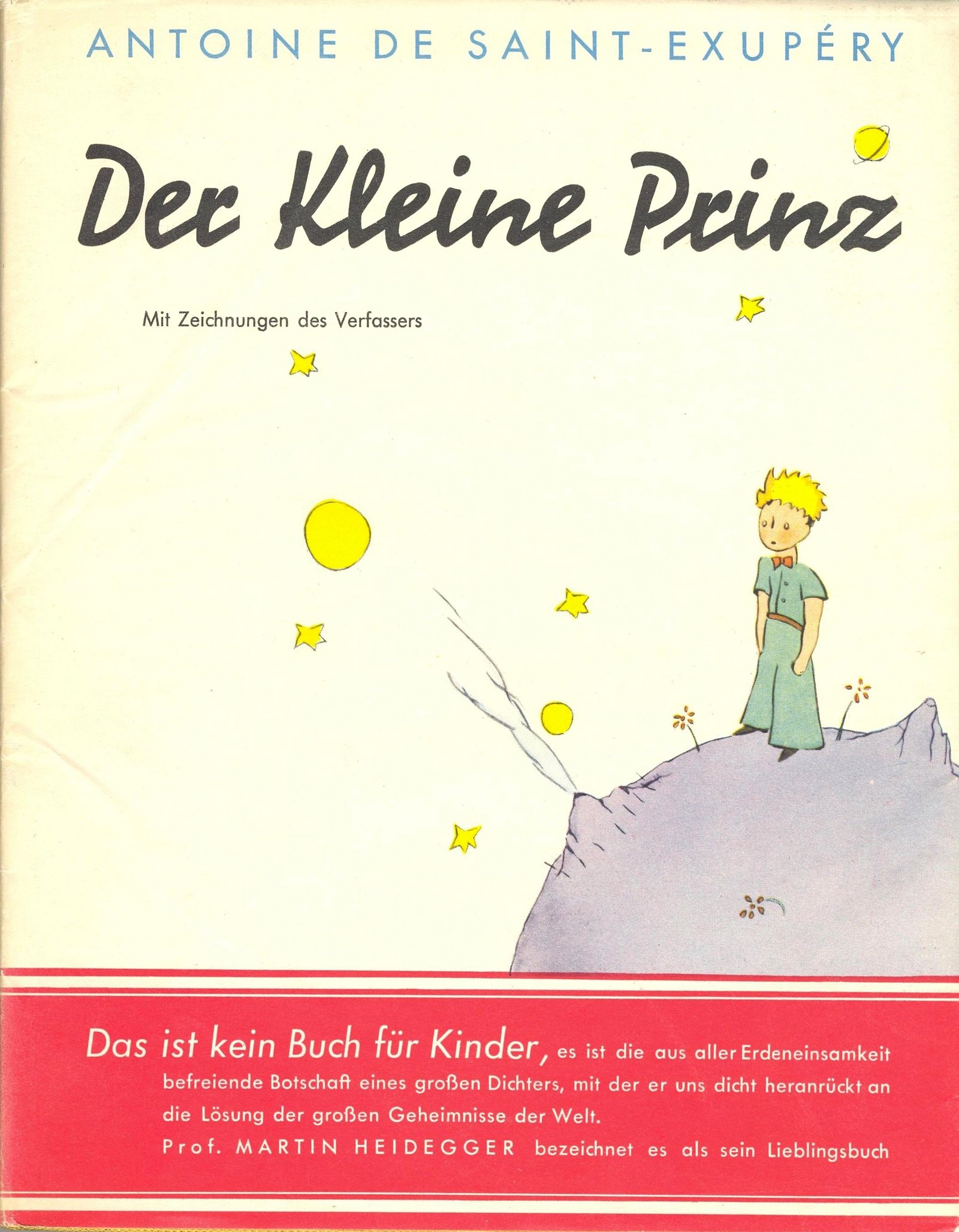
The publisher also added that Heidegger regarded the work as his favorite book. While the circumstances surrounding the publication of this endorsement are not documented and could potentially be a mere marketing strategy, the statement was publicly attributed to Heidegger by the reputable German publisher, Karl Rauch Verlag.
Heidegger's appreciation of Saint-Exupéry was not confined to this endorsement. On the occasion of giving a talk in honor of Ludwig von Fickers, Heidegger cited a passage from Saint-Exupéry's posthumously published book Citadelle:
Fonde l'amour des tours qui dominent les sables.
He translates it as
Stifte die Liebe zu den Türmen, denn sie beherrschen die Wüste.
I read Saint-Exupéry's passage as "Foster a love for the towers that dominate the sands." Heidegger then devotes three paragraphs to interpreting the phrase, connecting it to themes that are central to his later philosophy, including devastation or desertification (Verwüstung), language, poetry, silence, and letting-be (Seinlassen). Although brief, this discussion demonstrates that Heidegger was familiar with Saint-Exupéry's work and regarded it philosophically significant enough to serve as a point of departure for philosophical reflection.
The relationship between the two figures should therefore be understood with a great deal of caution. The documentary record does not support claims of direct influence or extensive dialogue. Nevertheless, Heidegger's endorsement of The Little Prince and his later engagement with Citadelle suggest that he recognized in Saint-Exupéry a writer whose work touched concerns close to his own philosophical project. Moreover, the affinity between Heideggerian themes and The Little Prince has often been noted by readers and commentators, despite the absence of any historical evidence of any direct contact between the two authors.
Against this background, the present essay examines several themes shared by Heidegger's philosophy and The Little Prince, particularly the role of the poet, the critique of modern technological society, authenticity and inauthenticity, dwelling and homelessness, sacred places, and mortality. Rather than arguing for historical influence, I suggest that Saint-Exupéry's literary world offers a remarkably rich and accessible disclosure of existential questions that Heidegger sought to articulate philosophically.
Being called a poet is not a minor detail when it is Martin Heidegger who does so. Before turning to Heidegger's view of poetry, it is useful to recall the broader orientation of his existential philosophy. Heidegger's central concern is the question of what it means to be human and how human beings can exist authentically in a world often dominated by conformity, distraction, and forgetfulness of Being. His analyses of anxiety, mortality, dwelling, and authenticity are all directed toward recovering a more originary relationship to existence itself.
The importance of Heidegger's endorsement of The Little Prince lies in the language he employed to describe it. Heidegger referred to Saint-Exupéry as being a "great poet," a designation that carries profound philosophical significance within his thought. For Heidegger, poetry is not merely a literary genre but one of the privileged ways through which truth is disclosed, and human beings are brought into proximity with Being.
For Heidegger, poetry is an absolutely necessary activity in the modern world—in which even philosophy is trapped in a metaphysical way of thinking that cannot lead to the Question of Being anymore. This question is one about Being itself and the meaning of Being, in contrast to what Heidegger thought Western metaphysics has been doing since Plato, namely, asking about the thing-in-being, entities, while forgetting about The Being itself. In other words, he is trying to understand what it means for an entity to be an entity at all. Rather than investigating the nature of entities, Heidegger argued that one should focus on studying the nature of being.
In her analysis of Heidegger's understanding of poetry and its relationship with philosophy, Angelina Nuzzo quotes from Heidegger when she writes:
Denken—philosophical thinking—must go back to its original unity with Dichten. Then and only then the destitution of the times can become apparent, and "the world's night, the abyss [Abgrund] of the world" can (as it "must") for the first time "be experienced and endured."
For Heidegger, poets are needed as they perceive the truth—the dangers of the modern world—and point them out. Hence, the French aviator and writer Antoine de Saint-Exupéry is, for Heidegger, one of the thinkers who can help modern society awake to the fundamental questions of human existence.
A few other characteristics make Saint-Exupéry fit Heidegger's description of the thinker or poet. First, he was, indeed, a genuine poet and artist. After failing in the academic world and becoming an aviator, he finally started doing what he always wanted: to write and create. Second, he wrote The Little Prince during his forced exile in the United States due to the war. According to a biography written by Paul Webster, Saint-Exupéry experienced loneliness and health problems while staying in a hospital in Los Angeles; there he wrote the basic ideas for this book. Awareness of death and anguish are, for Heidegger, the main experiences that trigger the Question of Being. Saint-Exupéry might have arrived at the thought-provoking messages of The Little Prince after having personally encountered these existential experiences—in combination with the opportunity of having lived through some moments of solitude in the hospital.
A final important detail is that, in those moments of solitude in the hospital, Saint-Exupéry remembers his mother's home, where he used to "dwell." He creates The Little Prince through this recall of his experience of dwelling. Webster reveals that, in a letter to his mother, Saint-Exupéry tells her that
he learnt of the immensity of life not from the Milky Way, the skies or the sea, but in the spare bed of her room where he slept when he was unwell as a child. [SE 243]
Webster adds:
In the Los Angeles hospital he drew on the memory of that pool of innocent comfort, keeping only one book beside him, a copy of Andersen's fairy-tales. His mother had related them to him in infancy and...this was the first story-book he ever read. [SE 244]
For Heidegger, poets are capable of opening up the world through dwelling, that is, through their experience of belonging to a specific and meaningful place where human life unfolds. If Saint-Exupéry's book was generated from this homesickness and his memory of dwelling in his mother's home, then he may very well be the kind of poet Heidegger describes.
If Heidegger regarded Saint-Exupéry as a genuine poet, the next question is what truth his poetry reveals. In The Little Prince, this truth is disclosed through a sustained critique of the world of the grown-ups. Their peculiar way of living exposes what Heidegger would call an inauthentic mode of existence. The contrast between authentic and inauthentic ways of being is one of the defining themes of Heidegger's philosophy, and Saint-Exupéry explores it as well by presenting different adult characters who embody distinct forms of existential forgetfulness. Indeed, the book ends with a sentence that condemns modern society's inauthentic way of living, in which people waste their time on useless matters, forgetting the important ones. The little prince exclaims:
And no grown-up will ever understand that this is a matter of so much importance! [LP 91]
This final sentence refers to an earlier conversation between the little prince and the pilot, where the little prince becomes furious after the pilot refuses to answer his questions, for he is "very busy with matters of consequence!" The little prince's reply to him reads,
I know a planet where there is a certain red-faced gentleman. He has never smelled a flower. He has never looked at a star. He has never loved anyone. He has never done anything in his life but add up figures. And all day he says over and over, just like you: "I am busy with matters of consequence!" And that makes him swell up with pride. But he is not a man—he is a mushroom! [LP 27]
Saint-Exupéry ends his book by exhorting the readers to open their eyes to the real world and thereby leave the world of figures. This means making a sustained effort to form an authentic relationship with the world, with others, and with themselves. This conversation echoes a central theme in Heidegger's philosophy, namely, the importance of uncovering the real world beneath the technological world—the world of figures—through connecting with the world in a different manner. In "The Question Concerning Technology," Heidegger states,
We are questioning concerning technology in order to bring to light our relationship to its essence.
The problem with technology is that it was supposed to be a tool humans could use to open up the world in a new way, but instead, it became who they are, that is, it formed their identity. Technology is not a tool anymore, but a fake world in which we live that conceals the real world. Given this, the problem is not technology itself, but the way humans interact with it. For Heidegger, the only way to reverse this situation is by asking the Question of Being, which can disclose the world as it really is. I advance the thesis that the character of the little prince is the illustration of someone who can live authentically in a technological world. An example of this is the scene in which a merchant offers him a pill to avoid being thirsty and save fifty-three minutes each day that human beings spend on drinking, to which the little prince answers:
If I had fifty-three minutes to spend as I liked, I should walk at my leisure toward a spring of fresh water. [LP 74]
Heidegger would say that the determining attitude is not whether one takes the pill or not, but the way in which one spends the time saved. Perhaps human beings can no longer escape the technological world, but at least they can choose how to live in it.
Regarding the topic of authentic and inauthentic existence, Stephan Käufer provides a clear summary of what Heidegger means by it:
Heidegger says that inauthentic, un-owned existence understands itself in terms of the world, or the successes and failures of its dealings, while authentic, owned existence understands itself in terms of its own being, namely the ability to be purposively.
In The Little Prince, inauthentic adults understand themselves exactly as Heidegger describes them: in terms of what they do or what they represent to others, instead of regarding themselves as free individuals with the ability to pursue possibilities. For example, the lamplighter, one of the adults the little prince encounters during his trip to the different asteroids, is trapped in a miserable way of existence for he understands himself as an employee who needs to turn on and off the light over and over, and nothing else (LP 47-50). He has no personal face; he is just what others tell him to do. The little prince cannot understand his way of living. In contrast, his own life is the example of someone who is aware of his reality of being-possible. For Heidegger, Dasein is fundamentally being-possible (Sein-können), meaning that human existence is not defined by a fixed essence but by its capacity to project itself toward future possibilities. Authentic existence involves recognizing and actively choosing among the different possibilities of what one might become rather than merely conforming to socially prescribed roles and expectations.
The Little Prince opens with a discussion of the problem of inauthenticity. While still being a child, the pilot shows one of his drawings to the adults, who—given their inability to understand it—advise him to stop painting and look for another profession. They not only limited his possibilities but also condemned him to become someone he was not. The pilot explains that this event led him to give up "what might have been a magnificent career as a painter" (LP 8). It is reasonable to conclude that Saint-Exupéry, like Heidegger, views inauthenticity as limiting the possibilities of being.
In the following paragraphs, I analyze some of the adult characters in Saint-Exupéry's book, as each of them highlights different critiques of modern society's way of living that are also present in Heidegger's philosophy. The confrontation of the little prince with the various adults is always presented as satire. After each encounter, the little prince reasserts his belief that adults are incomprehensible, remarking with puzzlement, "grown-ups are certainly very, very odd" (LP 43). Through these encounters, Saint-Exupéry criticizes modern man's preoccupation with useless pastimes, wealth and power, and technology. In his view, these meaningless worries make them miss the essential aspects of life, which are friendship and love.
After leaving his planet, the little prince visits six different asteroids before arriving on Earth. On the first two asteroids, he meets a king and a conceited man. It does not take long before he grows tired of them and moves on. In the little prince's eyes, they are simply too self-absorbed. Saint-Exupéry seems to be criticizing here the extreme anthropocentrism of modern society. These characters are so engrossed in themselves that they lose sight of the world around them. A literal illustration of this absolute self-centeredness is the king's robe, which covers his entire asteroid—to the point that it is impossible for the little prince not to stand on it (LP 35). For Heidegger, an essential problem of modern society is that anthropocentrism replaced God with reason, only to be displaced in turn by technology. As a result, the world and, more tragically, human beings increasingly come to be understood according to technological standards, that is, in terms of their usefulness. Just as the king wants to use the little prince to acquire a subject and the conceited man wants to use him to gain an admirer, individuals in the technological world increasingly relate to one another as resources to be used. Within such logic, there are only two possible categories for human beings: those who are useful or those who are not.
The next asteroid is inhabited by a tippler, who drinks to forget he is drinking. This character represents Saint-Exupéry's and Heidegger's concern regarding the oblivion of being. The tippler is so far away from the Question of Being that he does not drink any more to avoid the feeling of anxiety of living inauthentically, but he now drinks to forget he is drinking. In other words, he even forgot why he was drinking in the first place. Drinking is just one of the ways in which human beings try to forget their genuine self. This attempt to escape from reality serves to avoid anguish and anxiety, increasingly common feelings in a world where the things that used to give sense to human beings' lives are disappearing—such as dwelling. In his book about spiritual psychology in The Little Prince, Eugen Drewermann states regarding the tippler,
instead of working on themselves and seeking out the roots of their self-hatred, such individuals prefer personal oblivion.
Heidegger acknowledges that the role of philosophy and poetry in the modern world is uncomfortable or disturbing, because they make individuals face anxiety. But, at the same time, perceiving these feelings is necessary if one wants to live authentically.
On the fourth and fifth asteroids, the little prince encounters the businessman, the "red-faced gentleman," and the lamplighter. I have already mentioned these two characters at the beginning of the section, but I will develop at this juncture some other aspects to do with the lamplighter, who represents a way of being absolutely shut to new possibilities. This figure lives a meaningless life because all he does is follow outdated orders. He is what he does; he is his profession, and nothing else. But, at least, this man—in contrast to the tippler—acknowledges his suffering. He admits, "I follow a terrible profession" (LP 48), and "I am unlucky" (LP 50). Heidegger would think the lamplighter's problem is that he cannot open himself to all his possibilities. For Heidegger, the way in which one realizes purely being-possible, is through the awareness of one's own imminent death. Death highlights two realities that would have been useful for the lamplighter to know: first, that I am limited and my life can end at any moment. This finitude reconfigures reality and opens one up to one's multiple possibilities. Second, dying is something nobody can do for me: it is absolutely individualized. So, death highlights that one alone is responsible for one's life and no others. The little prince seems to be comforted when he finds the lamplighter thinking about something else rather than just himself—unlike the other characters he met. But Heidegger would argue he is not thinking at all, but just living as man, as a "they" without individuality. This lack of individuality constitutes the reason for such misery.
Finally, the little prince meets the geographer. This character exposes a similar problem to that of the lamplighter: he just identifies himself with his profession. His profession forces him to have a very narrow understanding of the world, as
the geographer is much too important to go loafing about. He does not leave his desk. [LP 53]
In contrast to the explorer—and, apparently, there are not many explorers because it is not an important profession—the geographer does not experience the real world. Living in direct engagement with the world is one reason Heidegger praises the life of farmers or peasants in texts such as "Why Do I Stay in the Provinces?" Heidegger suggests that, especially in today's technological world, dwelling in close relation to a place and its natural rhythms offers a privileged openness to Being. He sought this form of dwelling by retreating to his hut in the Black Forest, where he believed he could reconnect with reality. Yet it is important to distinguish Heidegger's voluntary retreat from the lived conditions of those whose livelihoods depend on the land. His experience of rural life was one of relative privilege, supported by material security, rather than the existential vulnerability that shapes the lives of many farmers and peasants. While Heidegger romanticizes a closer relation to nature, for those who depend on it for survival, such a relation is often both deeply meaningful and materially precarious.
Up to this point, Saint-Exupéry has diagnosed the different forms that inauthentic existence can take. The question that remains is how such a condition can be overcome. Here, Heidegger and Saint-Exupéry once again converge. Both suggest that authentic existence cannot be achieved only through effort or rational calculation but requires a special kind of disclosure that transforms the way one encounters the world. Heidegger describes this possibility through the language of the coming of a god: a transformative disclosure of Being capable of overcoming the spiritual and existential crisis of the modern age. The Little Prince offers a literary expression of this same idea through the encounter of the pilot and the little prince. When the little prince goes back to his planet, the pilot is worried about forgetting what he has learnt through their encounter. He fears becoming
like the grown-ups who are no longer interested in anything but figures. [LP 19]
The little prince is the one who awakens the pilot to a more authentic way of living. In this sense, he functions as a revelatory figure whose message transforms the pilot's understanding of himself and the world. Similarly, in his interview with Der Spiegel, Heidegger expresses the following conviction:
Philosophy will not be able to effect an immediate transformation of the present condition of the world. This is not only true of philosophy, but of all merely human thought and endeavor. Only a god can save us. The sole possibility that is left for us is to prepare a sort of readiness, through thinking and poetizing, for the appearance of the god or for the absence of the god in the time of foundering...for in the face of the god who is absent, we founder. [OG 107]
In this paragraph, Heidegger argues that the only way to awaken modern society to the Question of Being and to an authentic life is through an external revelation. Saint-Exupéry might be suggesting the same idea. This interpretation is reinforced by several elements that evoke Christian imagery, not because the little prince is presented as a direct representation of Jesus, but because his words and actions occasionally resonate with the Gospel narratives. For example, when he asks the pilot to give him water from the well (LP 78), he employs words similar to those Jesus uses in the scenes of the cross and of his encounter with the Samaritan woman. Also, the name of "the little prince" suggests he is the son of a king. Finally, the little prince anticipates and willingly accepts death because it is the only way to return to his rose, whom he left behind alone on his planet. This acceptance of mortality and death further contributes to the Christian resonances of the narrative without explicitly noting a similarity between the two figures.
Going back to the idea of the need of some sort of divine revelation to live authentically, the little prince lives on Earth for a year before going back home, a period in which he transforms the pilot's life. In the same way the little prince changed the pilot's life, Saint-Exupéry—through his brilliant book—did not change the course of history, but hopefully made many readers reflect upon their own lives. As Drewermann notes,
the world hasn't changed since the Little Prince walked on it; but it's possible to see it through his eyes. And many things that we now take seriously will strike us as ridiculous, and vice versa. [RC 17–8]
The king, businessman, tippler, lamplighter, and geographer all embody different forms of inauthenticity. The next section explores another key condition most adults in the book share: none of them truly dwells. Their lives unfold without rootedness, belonging, or attachment to place. This underlying homelessness is another central existential theme linking Saint-Exupéry and Heidegger.
Homesickness and homelessness can lead humans to ask the Question of Being. This proposition is rooted in Heidegger's concept of dwelling. In Heidegger's words,
the manner in which we humans are on the earth, is buan, dwelling. To be a human being means to be on the earth as a mortal. It means to dwell. [BDT 349]
Dwelling in the sense of having a home is a recurrent topic in The Little Prince as well. However, only the little prince shows feelings of homelessness and homesickness. Adults in the book are portrayed as people without homes. The six adult characters of the asteroids are so worried about themselves, or about forgetting, or about others' opinions that they do not even know where they live. The king, for example, conceals all his asteroids under his robe, the geographer does not care about knowing his planet by himself, and the lamplighter lives in his workplace because working is all he does.
In addition to the adults on the asteroids, there are two main scenes in which the absence of dwelling is clear. First, in the conversation the little prince has with the flower from the desert. He asks the flower where he could find human beings, and the flower replies,
I saw them, several years ago. But one never knows where to find them. The wind blows them away. They have no roots, and that makes their life very difficult. [LP 59]
This remark implicitly suggests that human beings need roots; without them, they are miserable. The lack of a place to dwell makes human beings' lives difficult. The other relevant scene is the one in which the little prince is dialoguing with the railway switchman. One reads in the book:
And a brilliantly lighted express train shook the switchman's cabin as it rushed by with a roar like thunder.
"They are in a great hurry," said the little prince. "What are they looking for?"
"Not even the locomotive engineer knows that," said the switchman.
And a second brilliantly lighted express thundered by, in the opposite direction.
"Are they coming back already?" demanded the little prince.
"These are not the same ones," said the switchman. "It is an exchange."
"Where they not satisfied where they were?" asked the little prince.
"No one is ever satisfied where he is," said the switchman.
And they heard the roaring thunder of a third brilliantly lighted express.
"Are they pursuing the first travelers?" demanded the little prince.
"They are pursuing nothing at all," said the switchman. "They are asleep in there, or if they are not asleep they are yawning. Only the children are flattening their noses against the window-panes." [LP 71-2]
In my view, this conversation illustrates how Saint-Exupéry believes people live in modern society. Several characteristics of such a life can be drawn from it. First, humans are constantly moving from one place to another for no apparent reason. This means that either they do not have a place to dwell or that they are not satisfied with the place they have—a common characteristic in a materialistic world that continually encourages people to want more than they already possess. Second, they will never change their situation of dissatisfaction, for they travel with their eyes closed. And third, since their eyes are closed and given the train's speed, they cannot feel anything. Without the feeling of homelessness, they cannot even recognize their reality of being homeless. Consequently, they will ride trains and remain restless forever.
In a brief 1934 essay, Heidegger states that only by staying home and in relation to the natives who live on that soil—in his case, the farmers and peasants who live in the Black Forest—can one be open to the Question of Being. He writes,
my whole work is sustained and guided by the world of these mountains and their people. [SP 28]
In a cosmopolitan world, where homes become transitory, people cannot truly dwell. And, if one cannot dwell, one cannot be fully human–as human beings are in the world through dwelling. In today's cosmopolitan world, people are unable to feel homesickness, for there are no homes anymore, nor homelessness, as the world has been transformed into something homogeneous that is constantly on the move. This lack of rootedness prevents human beings from asking the Question of Being and, thereby, from living meaningfully. For example, in his paper "At home with Hegel and Heidegger," Simon Lumsden points out that Heidegger describes homesickness as "the fundamental 'attunement' of philosophy." Philosophy cannot be done in a world where people have eradicated homes.
Returning to Saint-Exupéry's book, only the little prince seems to be someone who dwells. Even before beginning his journey, for example, he starts feeling nostalgic about leaving his asteroid:
He believed that he would never want to return. But on his last morning, all these familiar tasks seemed very precious to him. [LP 32]
On Earth, he also shows signs of homesickness; for example, when he wants to see a sunset and remembers that on Earth it is not possible to do so by moving the chair, and exclaims,
I am always thinking that I am at home! [LP 25]
A final example appears when he remembers the anniversary of his descent to Earth with "a queer sense of sorrow" (LP 80).
Yet dwelling is not merely a matter of inhabiting a geographical location. For both Heidegger and Saint-Exupéry, dwelling transforms space into place by investing it with meaning through relationships. This transformation occurs when the place begins to mean something to the individual, rather than being merely a landscape or a crossing point. Homes, for instance, are not simply buildings but places that have become meaningful through lived experience. Heidegger describes this distinction by contrasting his own experience of the Black Forest with that of a tourist or visitor:
Strictly speaking I myself never observe the landscape. I experience its hourly changes, day and night, in the great comings and goings of the seasons...all of this moves and flows through and penetrates daily existence up there, and not in forced moments of "aesthetic" immersion or artificial empathy, but only when one's own existence stands in its work. [SP 27]
The Little Prince illustrates this same transformation in two memorable scenes. In both, an ordinary landscape becomes a meaningful place because it comes to embody a unique relationship between two individuals. The first scene is the one between the fox and the little prince. The little prince must leave, and he feels unhappy since the fox is crying. He blames the fox for making him tame him, yet the fox replies that it was a good idea "because of the color of the wheat fields" (LP 68). Those wheat fields that once meant nothing to the fox, as he does not eat wheat, now remind him of the little prince and his blond hair. The fields became a sacred place for him, and now he can look at them and laugh. The second such scene is the farewell between the pilot and the little prince. Having learned from the fox, the little prince now explains to the pilot that, as a result of their relationship, stars have become a special place for him. He explains to the pilot:
In one of the stars shall I be living. In one of them shall I be laughing. And so it will be as if all the stars were laughing, when you look at the sky at night...You—only you—will have stars that can laugh! [LP 85]
The transformation of ordinary places into meaningful ones depends on relationships. Yet those relationships acquire their full significance only because they are finite. This is why the final movement of The Little Prince turns toward death, the experience that reveals what matters most.
When the little prince first reaches Earth, he meets a snake who tells him:
I can help you, some day, if you grow too homesick for your own planet. [LP 58]
Through the venom of the snake, the little prince dies and goes back home. Since his arrival on Earth, the little prince is aware of the possibility of death. This awareness opens to him the possibility of going back home. The little prince's relationship with death can be a metaphor of what Heidegger argues: that there is no plenitude, no possibilities, no freedom and no choices if a human being does not recognize that death is an imminent possibility.
For Heidegger, death is not primarily an event that occurs at the end of life but the most personal possibility that accompanies Dasein throughout its existence. Heidegger employs the concept of Dasein to refer to the way in which human beings exist in the world. Since no one can die in someone else's stead, death individualizes humans and calls them away from their anonymous existence of das Man. In that sense, as George Pattison explains, death for Heidegger reveals the finitude that characterizes human existence, exposing the limits of every human possibility and of human self-understanding. Heidegger's analysis of death is therefore not concerned with biological extinction but with how confronting one's own finitude transforms the way Dasein understands itself (HD 9). Inspired by Kierkegaard, Heidegger describes the mood that discloses this finitude as Angst (anxiety). Rather than something to be avoided, anxiety reveals death as an ever-present possibility that reorients the way human beings understand and inhabit their lives.
According to Heidegger, one cannot live in plenitude without confronting one's own death, for confronting one's own death means understanding that Dasein amounts to being incomplete—always in the process of becoming more—or being-possible. Awareness of one's finitude reconfigures reality for each human, for when one realizes there is a limited time to live, one can open one's eyes to what life offers—to all the possibilities in the world that can be pursued.
Viewed in this light, the little prince's acceptance of death is not merely a narrative ending but an existential awakening that enables him to act authentically in relation to what matters most to him—thereby making it possible for him to reunite with his rose. The rose symbolizes more than a beloved individual. Throughout the story, the rose represents the little prince's deepest attachment and responsibility—the being for whom he cares and to whom he remains faithful. His desire to return to the rose, therefore, reveals what is most meaningful in his life.
A final methodological clarification is needed. The purpose of this essay has not been to demonstrate that Saint-Exupéry consciously adopted Heidegger's philosophical ideas. Such a claim would exceed the available evidence. Rather, the analysis has proceeded from the observation that literary and philosophical works often converge upon similar questions despite emerging from distinct intellectual contexts. Heidegger himself maintained that poets and thinkers frequently explore the same truths through following different paths. In this sense, the value of a Heideggerian reading of The Little Prince lies not in proving the existence of influence but in illuminating the existential depth of a literary work that continues to speak to readers across generations.
Seen through a Heideggerian lens, The Little Prince emerges as a profound exploration of existential themes. Saint-Exupéry's portrayal of authenticity, dwelling, and the role of the poet echoes Heidegger's philosophical concerns. As Heidegger suggests in his comment on the book, The Little Prince offers insights into the "great mysteries of the world" by awakening readers to the dangers of modernity and the possibilities of authentic existence. Saint-Exupéry may be understood as exemplifying what Heidegger calls the poet, one who reveals truths about Being and the dangers of an inauthentic existence. By crafting a narrative that critiques the forgetfulness of essential existential questions, Saint-Exupéry fulfills the poetic role of awakening humanity to the crises of modern society.
Both Heidegger and Saint-Exupéry express a deep concern regarding the eradication of homes, a condition exacerbated by the cosmopolitanizing and technological domination of the modern world. They both highlight the existential importance of rootedness and belonging, with Saint-Exupéry's reflections on dwelling aligning closely with Heidegger's emphasis on the interplay between Being and place. Furthermore, the treatment of death in The Little Prince aligns strikingly with Heidegger's philosophy. The little prince's continual awareness of death as a possibility and his eventual acceptance of it as a means of returning to his rose mirrors Heidegger's idea that acknowledging finitude is essential for embracing life's possibilities and achieving authenticity.
Heidegger refers to poets and writers as thinkers. These thinkers are not common in the modern world, where social conformity and technological modes of thinking (currently exacerbated by the adoption of artificial intelligence language models) can make reflection on fundamental existential questions increasingly difficult. Thinkers are individuals capable of recognizing and articulating the current crisis of meaning and originality. Heidegger's remarks on The Little Prince, together with his later remark in Citadelle, suggest that he recognized in Saint-Exupéry a writer whose work touched concerns close to his own philosophical project. Philosophers can think, but poets express these thoughts in a way that may be read and experienced by people who normally would not turn to philosophy. So, one of the main advantages of using literature in the treatment of philosophical topics lies in the capacity of literary works to reach a wider audience than philosophical works can.
Additionally, too frequently today, philosophy has only a place in a corner of universities, a corner not all students have access to unless they decide to take courses in a designated philosophy department. The value of academic philosophy has gradually shifted from knowledge all students should have to increasingly specialized debates addressed primarily to professional philosophers. As a result, philosophical reflection is no longer considered important for personal development and pondering questions about life. In this context, poets and literary writers have come to play a fundamental role in awakening individuals to the essential questions of existence.
The enduring significance of The Little Prince may lie precisely in its ability to communicate philosophical insights through poetic language. Saint-Exupéry addresses questions of authenticity, dwelling, mortality, and meaning, yet he does so in a language that reaches far beyond the boundaries of academic philosophy. Few readers will recognize the Heideggerian themes explored in these pages. Nonetheless, the book's enduring appeal may lie in its capacity to awaken a sense that something essential has been forgotten. Rather than offering solutions, The Little Prince invites readers into a deeper encounter with themselves, others, and the world, that is, a journey that may reveal new possibilities for living meaningfully.


